Retrovirology · RNA biology · AI for science

Experimental &
computational biologist.

Investigating how viral mechanisms shape biology—from HIV integration to neuronal RNA communication.

I connect molecular biology and biochemistry with transcriptomics and Python, and develop tools at the intersection of biology, education, and AI.

RetrovirologyRNA biologyEndogenous retroelementsTranscriptomicsAI for scientific discovery

Research

Questions that connect the bench and computation.

From molecular mechanism to RNA-sequencing data, my work examines how retroviruses and retroelement-derived systems interact with cells.

RNA biology & transcriptomics

Arc: from particle biology to RNA cargo

How does Arc assemble, leave cells, and associate with RNA?

I study Arc, a retrotransposon-derived Gag-like neuronal protein involved in synaptic plasticity, learning, and memory. My work connects molecular biology and biochemical assays with the analysis of RNA cargo in Arc-associated particles.

Using Python and RNA-seq, I examine RNAs derived from endogenous retroviruses, LINEs, SINEs, and other transposable elements. This computational work began at Columbia and remains ongoing.

Molecular biology · Biochemistry · Cell culture · Python · RNA-seq
Retrovirology & host–virus interactions

HIV-1 integration & TREX1

How do host enzymes influence the fate of viral DNA?

My doctoral work showed that TREX1 promotes HIV-1 integration by preferentially degrading unprocessed viral DNA. Collaborative studies extended this work to the biochemical basis of substrate selectivity and integration defects in immune-escape mutants.

Assay development · Viral DNA integration · Protein–DNA biochemistry

Additional experimental experience

Three screening approaches to a block in M-PMV

I investigated host factors using a CRISPR knockout screen, host-protein add-back experiments, and an siRNA screen. The work provided experience with complementary perturbation strategies, though the screens did not resolve the block or identify a conclusive host factor.

High-throughput functional screening · CRISPR knockout · Protein add-back · siRNA

Experimental & computational toolkit

Methods in service of the question.

Experimental biology

Designing assays and cellular systems to investigate molecular mechanisms.

  • Molecular biology & biochemistry
  • Mammalian cell culture & stable cell lines
  • Retrovirology & host–virus interactions
  • Biochemical assay development
  • High-throughput functional screening
  • CRISPR knockout, siRNA & protein add-back
  • Protein, DNA & RNA characterization

Computational biology

Connecting sequencing data with biological interpretation.

  • Python & bioinformatics
  • RNA-seq analysis & transcriptomics
  • Transposable-element-derived RNA analysis
  • Microarray data analysis
  • Quantitative analysis of biological data

AI & scientific software

Developing tools that make scientific information easier to examine and use.

  • AI-assisted literature discovery
  • Scientific information extraction
  • Research workflow prototyping
  • Interactive scientific interfaces
  • AI-assisted biology learning tools

Selected publications

Research in the literature.

Manuscript in preparation

ArcHIVed viral memories: Uncoating, release, and packaging. Davids, B.-O., & Goff, S.

Teaching & mentorship

Learning biology by doing science.

Adjunct Assistant Professor
Queensborough Community College, CUNY

BI-201 · General Biology I Laboratory

I guide students through hands-on experiments, scientific reasoning, and data analysis. Active questioning, collaborative interpretation, and concrete examples help students connect biological concepts with the evidence they collect.

My approach is to help students evaluate explanations and apply biological principles, while making space for questions about research, graduate study, and careers in biology.

Upcoming teaching: BI-202 General Biology II lectures and BI-170 biology for nonmajors are scheduled for later in Fall 2026.

Teaching & service in my CV

AI & science

Building tools for scientific thinking.

I am interested in AI that helps researchers examine evidence, develop testable hypotheses, and interpret biological data.

AI for scientific discovery · Active development

SimplScience Research

I am developing SimplScience Research to help turn scientific literature into a foundation for computational investigation. It brings together my work on scientific information extraction, relevant-study discovery, and AI-assisted research workflows.

Explore SimplScience Research

Current foundation

Find studies. Extract information.

Identify relevant literature and extract scientific information that can inform a research question.

Development direction

Connect evidence to analysis.

Group related studies and use the resulting evidence to guide downstream computational work, including RNA-seq analysis.

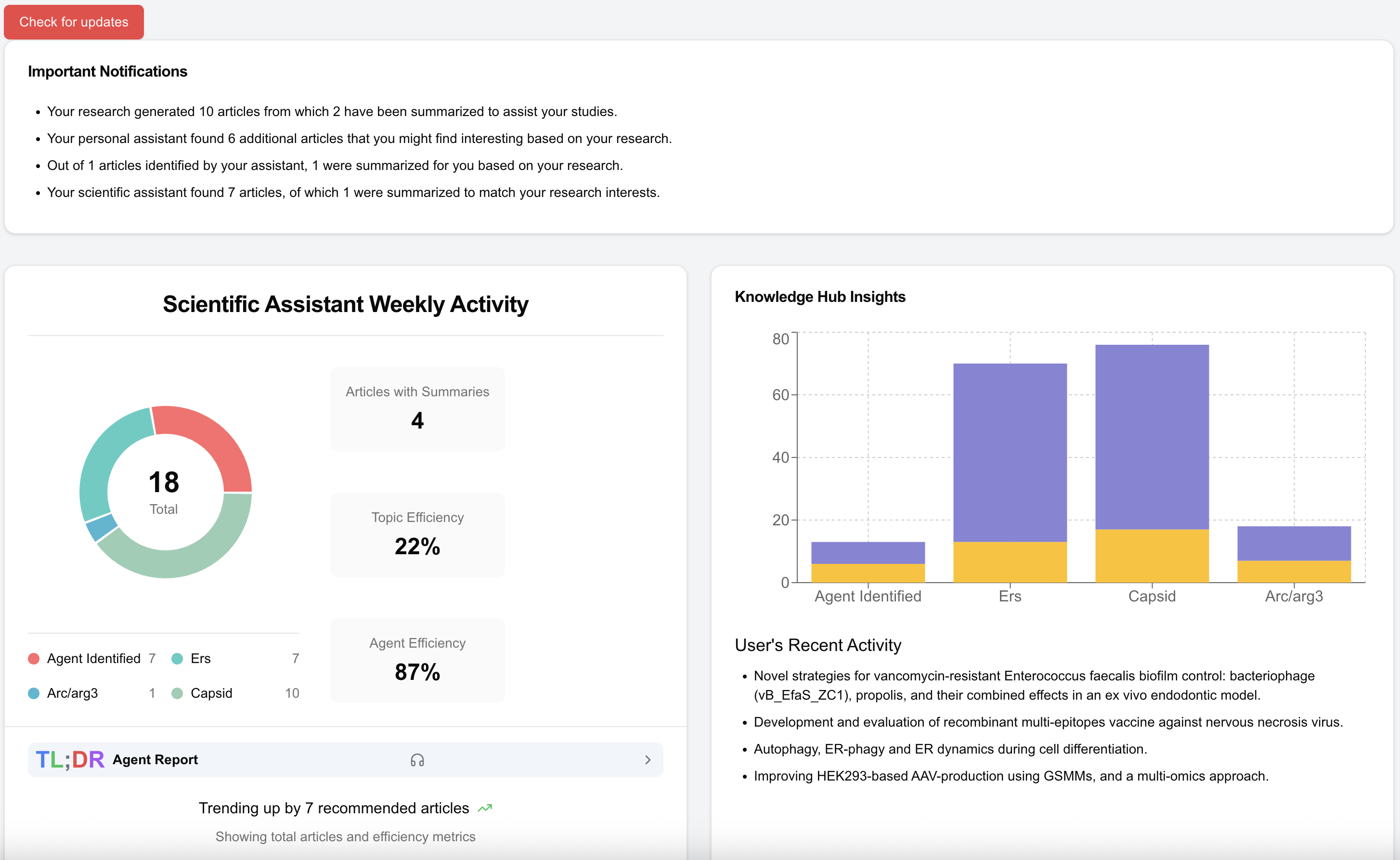
SimplScience Research dashboard showing discovered articles, topic collections, summaries, and recent research activity
A look inside SimplScience Research. A dashboard preview from the product’s public website, showing article discovery and topic collections. Displayed counts illustrate the interface, not a performance evaluation. View full-size image ↗